Choosing Materials for Luxury Interiors: What Actually Matters
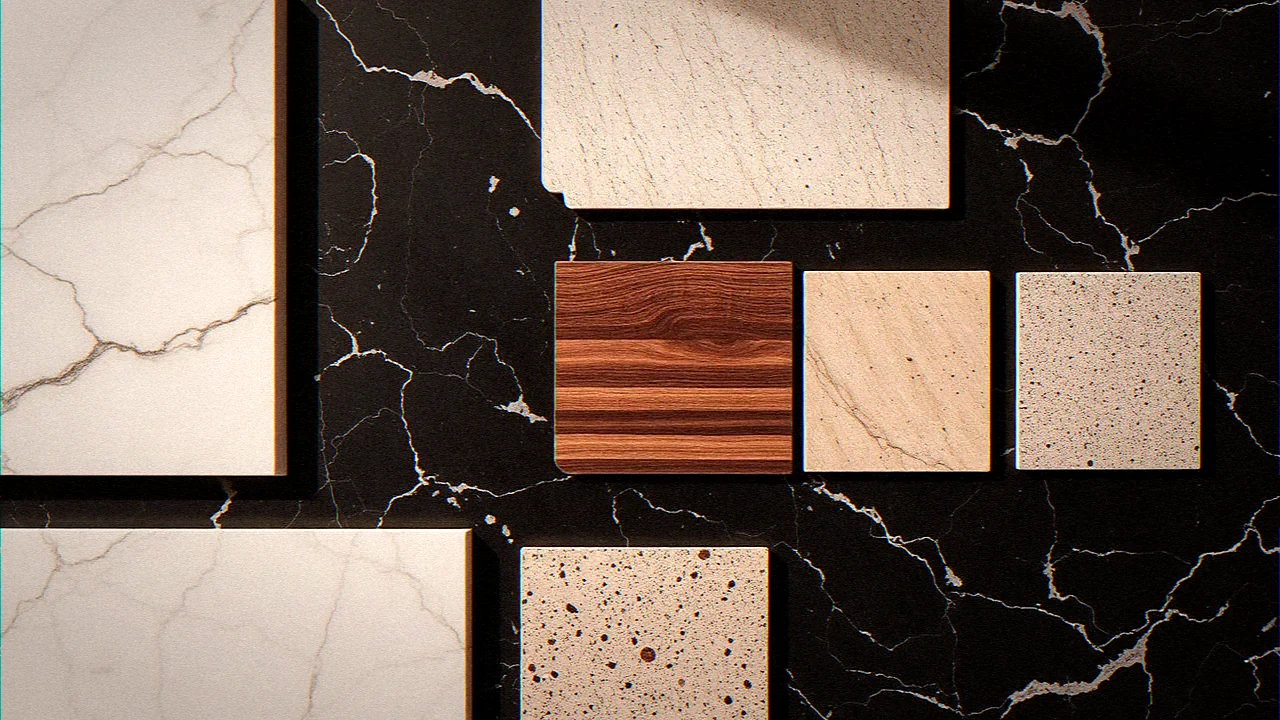
Most material disasters I've seen on luxury projects didn't start with a bad slab. They started with somebody falling in love with a sample in a showroom before anyone had asked how it would actually live in the room.
The order matters: brief, then function, then aesthetics. Skip the first two and you'll spend the project apologising for a finish that doesn't behave.
Marble, briefly
Carrara is everywhere for a reason, it's relatively forgiving, well-priced for the category, and you can pretty much always source it. Calacatta is the one people want when they say the white one with the gold veins; it costs more and the supply is more uneven. Statuario is the showy one, with the most dramatic veining; you book-match it on a feature wall and it does the talking.
The one thing I'd push on, every time: get physical samples and view them under the lighting conditions of the actual room. Warm halogen and cool LED make the same slab look like two different materials. I've watched clients reject a perfect marble because they only ever saw it under shop lights.
Wood, engineered, mostly
For floors, engineered oak has quietly won. You still get the visual warmth of solid wood but it actually copes with underfloor heating and humidity swings, which solid plank doesn't. We source most of our oak and walnut from FSC-certified European mills, Austria and the Nordics are the most reliable for grading consistency.
If a client insists on solid plank for a project with underfloor heating, my job is to talk them out of it. Some of the time it works.
Stone and terrazzo
Travertine is back, with the rougher honed finishes most architects ignored for a decade. Terrazzo too, and not the standard catalogues. The interesting work is bespoke aggregate mixes from manufacturers who'll let you specify the chip size and the colour ratio. It takes longer to spec but the result is genuinely one-off.
Large-format porcelain, say it quietly
The 160×320 cm porcelain slabs that imitate marble are, for high-traffic commercial spaces, the right answer more often than people admit. You get the look, you skip the maintenance nightmare, and your client doesn't have to lecture cleaners about pH-neutral products forever. For a hotel lobby it's pragmatic. For a master bathroom in a private house, still real marble, every time.
Render it before you order it
If there's one habit I'd recommend to any architect or designer reading this: pair every serious material choice with a photoreal render of the actual room. A 2D moodboard tells you the material is beautiful in isolation. A render tells you whether the veining direction works with the joinery and whether the colour holds up against the planned lighting. We get fewer change orders on projects that do this and more on projects that don't.
Then, still, get the physical sample. Renders are great for elimination. Final sign-off is in your hand, under the right light.
A note on sustainability
Luxury and FSC certification are not enemies, despite what some old-school suppliers will tell you. The serious quarries and mills now publish lifecycle data on request. If they don't, that's a tell.
Related services
Related articles
3D Rendering vs 3D Printing: Which Scale Model Sells Faster?
Tactile 3D-printed scale models or cinematic photoreal renders, which one actually closes luxury real estate deals faster, and when to use both.
CGI vs Photography for Interior Designers: When Each One Wins
A practical comparison from someone who commissions both every week, cost, flexibility, realism, and the situations where one quietly beats the other.
5 Architectural Visualization Trends Shaping 2026
Real time engines, AI in post, VR walkthroughs and a few honest opinions on what's actually changing in archviz this year.
Got a project in mind?
Send us a few lines and we'll get back to you within a couple of days.
Get a Free Quote